

This research project aims at understanding the Indian mid-tier consumer for price range $200-$350, and their needs to use the power of Artificial Intelligence to enable a more meaningful smartphone experience. This project guided the principles for design iterations impacting core Samsung Apps like Call, Messaging, Gallery, Camera, Battery Usage etc.
Artificial Intelligence is a key differentiator in the intensely competetive global Smarphone market and India, being a fast growing market, poses a great challenge for all brands dure to its vast diversity and distinct user behavior.
This project was initiated with a wide approach to understand the Indian mid-tier consumer (defined here as users of smartphones worth Rs 15k-25k ($200-$350) and their needs to use the power of artificial intelligence to enable a more meaningful smartphone experience.
The impact will eventually be in the day-to-day interactions with smartphones including core apps and functions like call, messaging, gallery, camera and battery usage etc.
With few reports specific to Indian consumer behavior and growing diversity, it was challenging to begin the research from scratch. We needed a good understanding of the target consumer to highlight their motivations and desires. With this we wanted to create a guiding principle for the project to proceed into Design Phase where the solutions were to be in alignment with the business needs and should be technically feasible by the next two years.
Our objective was to create a platform for innovation backed with AI by understanding key user needs for the target consumers considered, that help define where and how Artificial Intelligence can enable a more meaningful smartphone experience.
Our main goals were:
We were a team of five members who conducted an exhaustive secondary and primary user research. We identified that 20-35 year olds are most influencing section of people impacting adoption of new features and technology and conducted in-depth interviews as it was important to understand their motivations and what delights or frustrates them in their day-to-day experiences.
This included spending time of a day ~9hrs with the user, conducting in-depth interviews, analysis and mapping the needs. We restricted the scope of research to the city of Bangalore due to budget and time constraints. We tried to include people who migrated here from Tier II and Tier III cities to have a diverse dataset.
The research resulted in 3 personas representing the Mid-tier Indian mindset and 6 key insights that directed the ideation for AI intervention in smartphones. Each insight helped generate multiple design concepts which were mapped with the business needs and technical feasibility.
We identified key principle characteristics for a smartphone AI assistant (a street-smart sidekick) that makes the experience more meaningful. The concepts developed into independent projects to be launched as app features in the devices to be launched in 2019-2020.
I unertook the early market research and framed the right questions for the interviews. I conducted 7 out of total of 17 interviews and later led the team to analyze and interpret the data collected to identify key mid-tier personas and insights to come up with creative concepts powered by AI.
I was one of the two senior members in the team who coordinated with the business and tech teams to map our design solutions with existing tech possibilities (for the next and coming 2-3 years) and marketing potential to lay the roadmap for AI driven projects for the coming years.
At the outset of this broad project, we did not have a clear understanding of how and where AI could intervene in the day-to-day experience of users since it can do any or everything.
We started with the objective to understand how users deal with their routine tasks and see how the smartphone they used made life better (or worse) for them...
We gathered a lot of data which became too complex to synthesize. We began clustering the user statements that hinted similar motivation behind the expectation, desire, or even pain points they shared.
We could see the similarity in priorities and what really meant moe for different groups of people. This helped understand the key mindsets of users and simplified the way forward.
Broadly, these priorities were:
Personas were needed to help us best capture and represent the motivations, desires, problems ad expectations of the diverse population and culture in India. This helped us focus in ideating since AI holds an immensely wide scope of intervention. We needed the 'WHO' for us to move forward.
Based on the above underlying 'Motivations' we developed the following three personas which we felt best reflect the target customer.
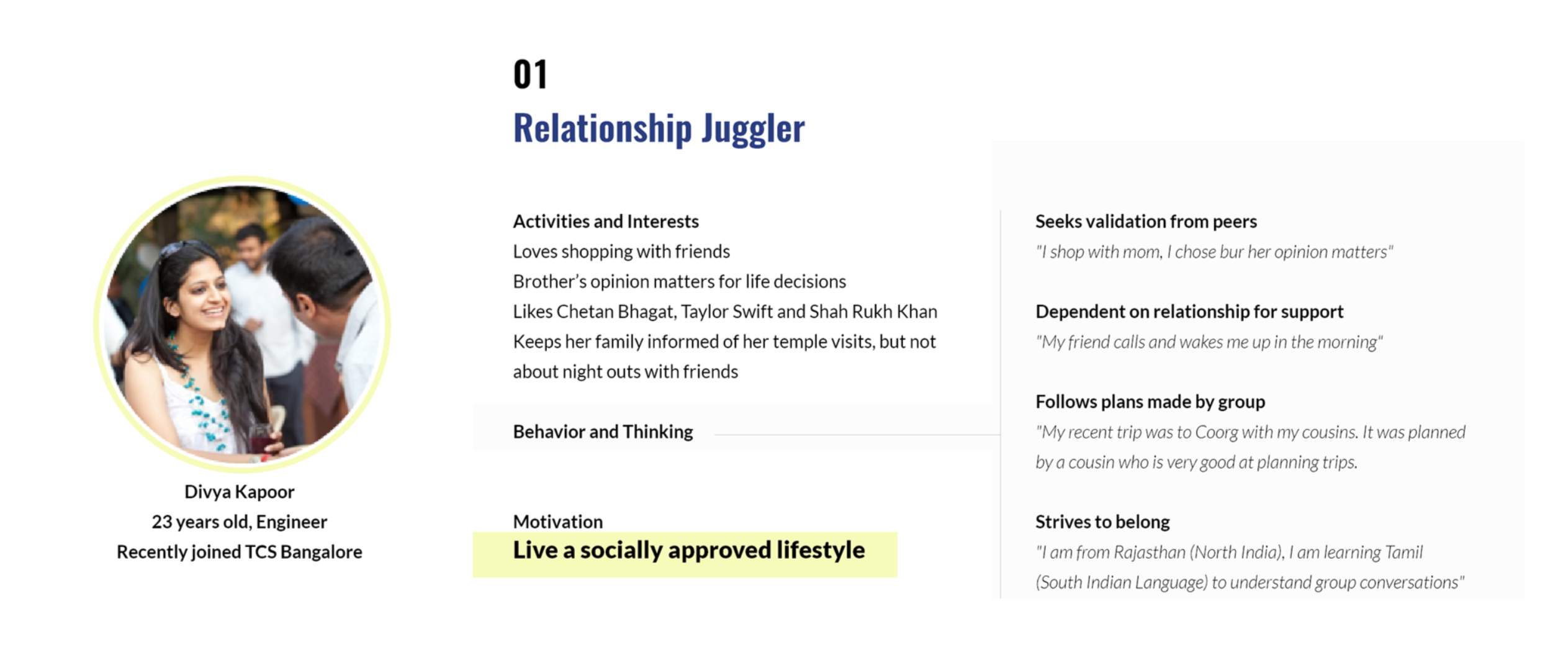
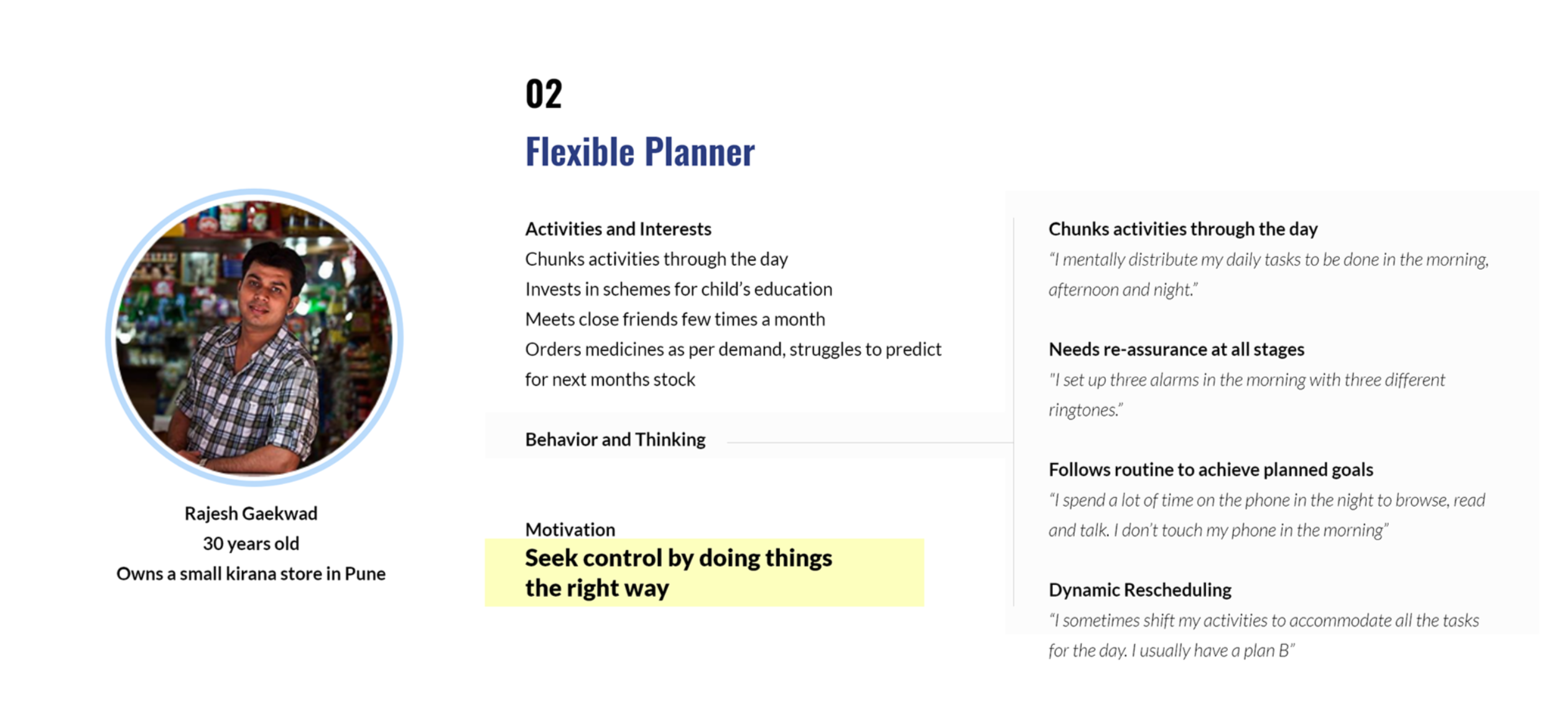
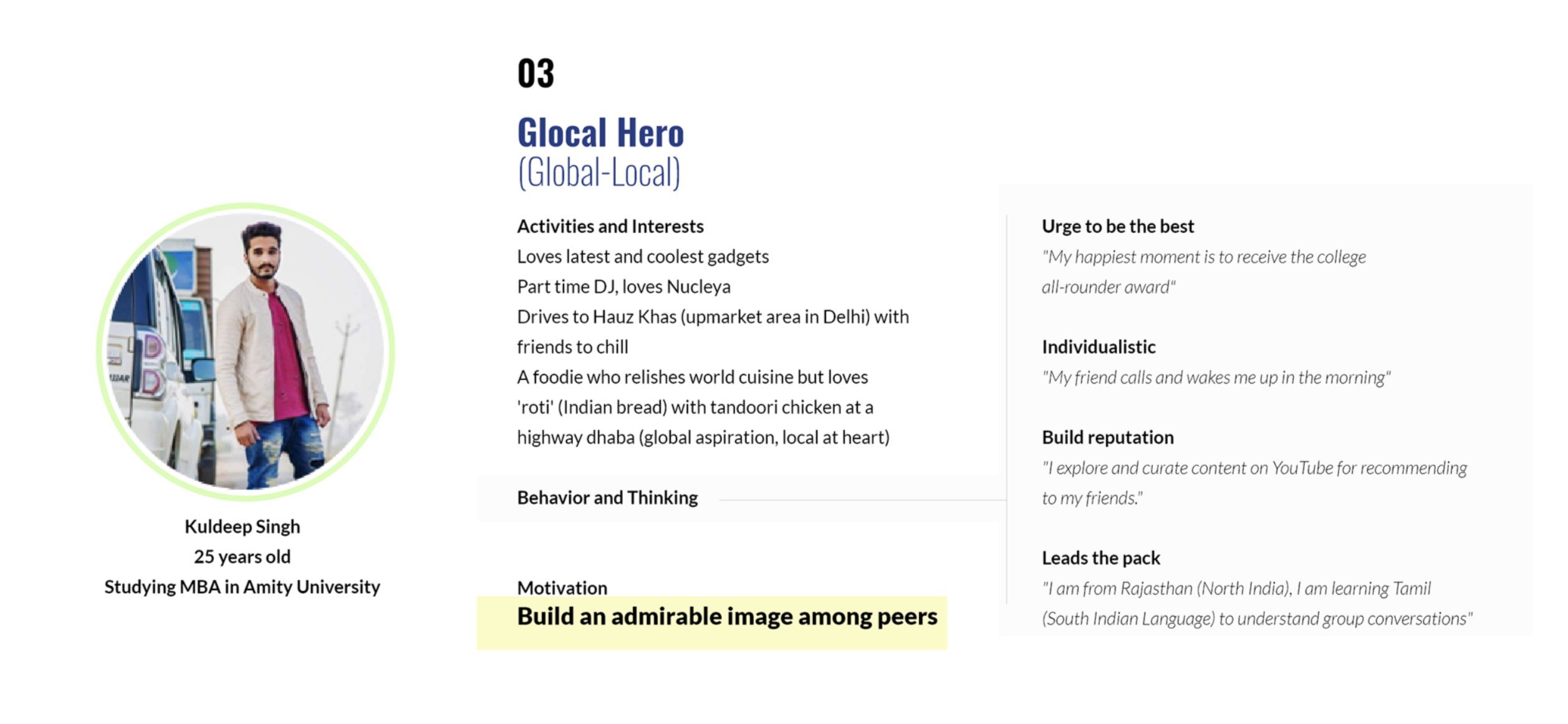
In parallel to the user interviews, we conducted secondary research about social trends regarding Gen Z & young millennials and Technology Trends through research reports by reputed firms, articles and blogs by accomplished personalities in the field.
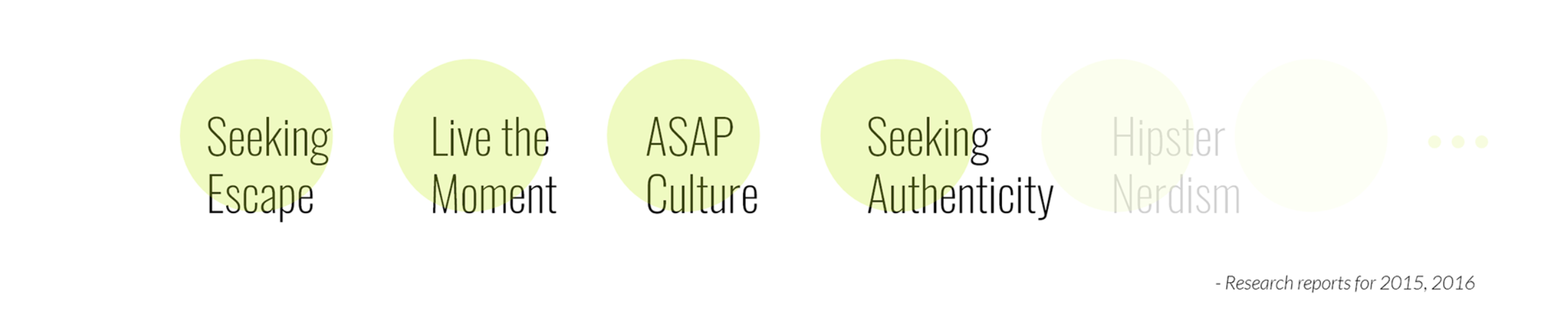
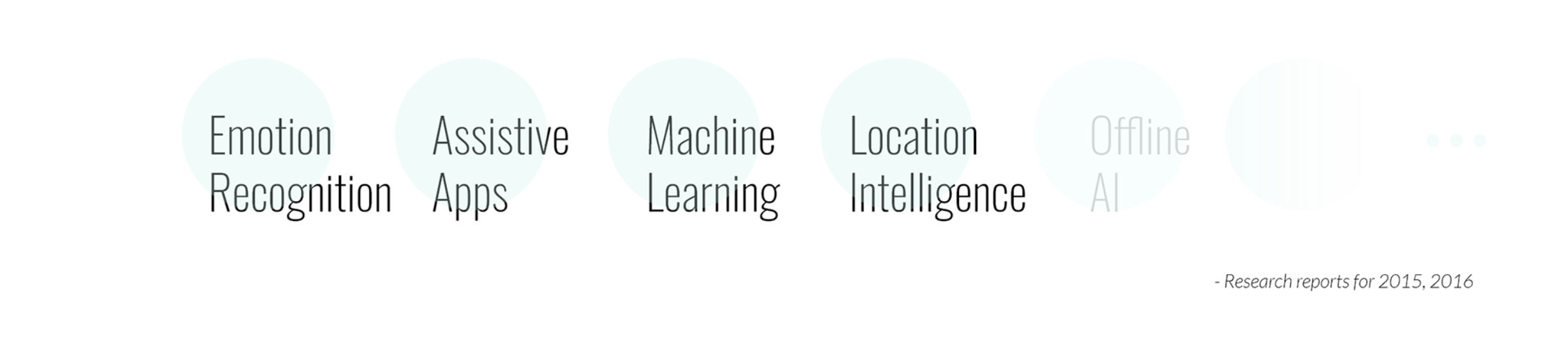
We saw that the clusters we created with similar significance of the user statements were in line with social trends as reported. This gave us confidence for our research and in fact, we found that these were the influencing the behaviors we observed in people.
There was a total of 14 clusters at the initial level but upon numerous discussions with team, we finally saw that there were actually six umbrella themes that represented the overall desires, pain points and behaviors of all users.
We defined these six clusters as the key user needs of the Indian mid-tier segment that will direct the ideation session and set the tone for the story of AI in India. These needs were figured as:
We were quite satisfied with the work done so far since we (Ux Team) could identify that AI can actually be the backbone of solutions to the needs found. We could now ideate and narrow down the immense possibilities AI can offer to these user needs and realy make life easier for the users.
But to define and validate te direction of moving ahead, we figured that this may be too broad for a common understanding of the Tech. & Business team for a smooth progress of the project.
For bringing other stakeholders on board with us, we had to simplify the above (which seemingly was enough for the UX team to begin ideation).
For Artificial Intelligence driven solutions for India Mid-tier segment
The study of social trends (behavior of millennials, Gen z....we now saw as 'influencers' to the needs we found) through reports by reputed research firms helped us validate the six user needs internally that helped bring the business team on board and technology trends guided us what tools could be used to 'enable' the solution for those needs. This triggered the role of tech team to share the existing feasible solutions.
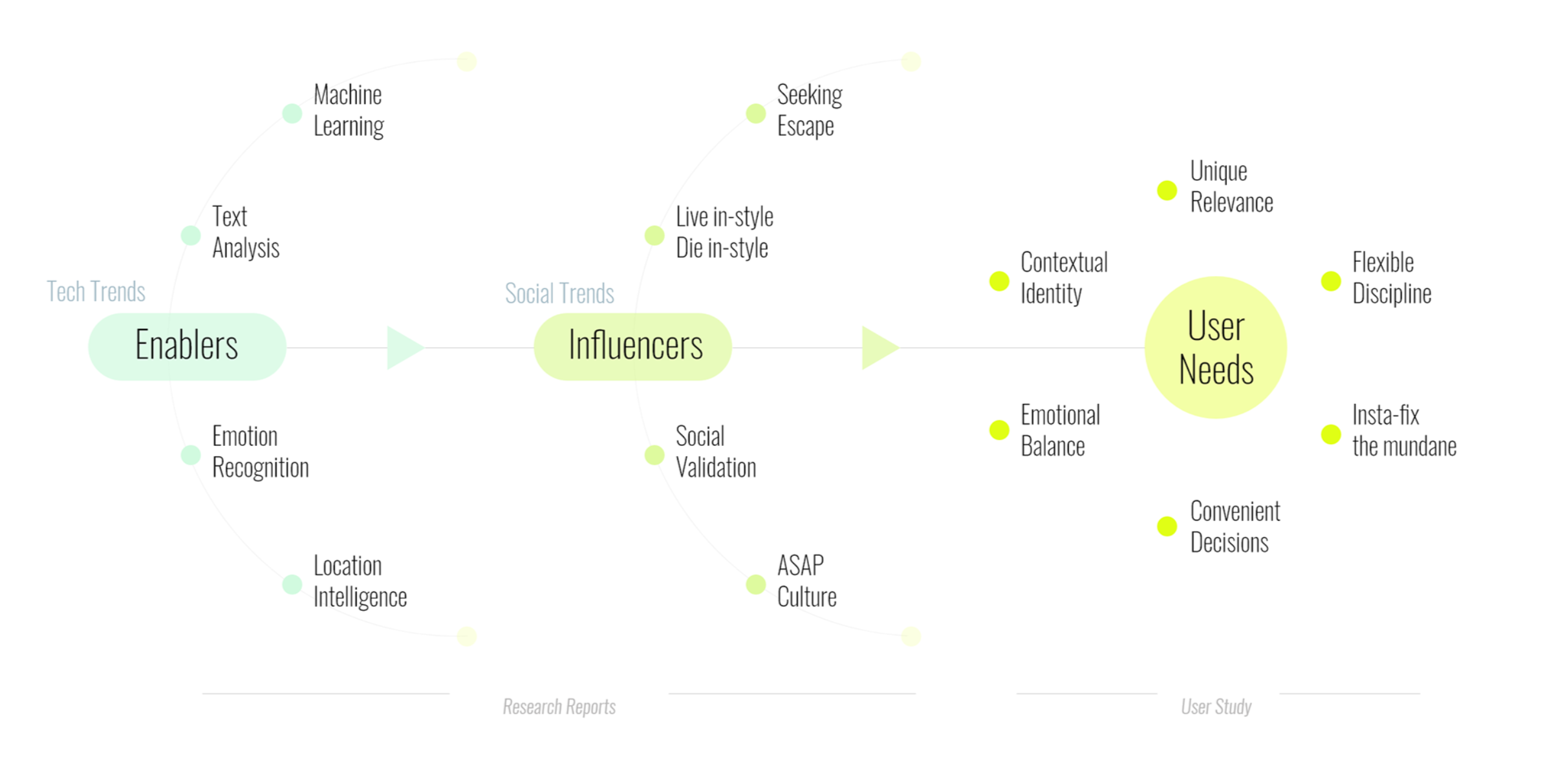
Moving forward, we realized that we may need to synchronize the user needs further into one large theme for simpler understanding since from here on, UX and Tech team could not work in isolation. There needed to be a coherent approach to build meaningful solutions for the users.
Upon further brainstorming, debates and discussions, we defined a single theme that captured
the 6 user needs.
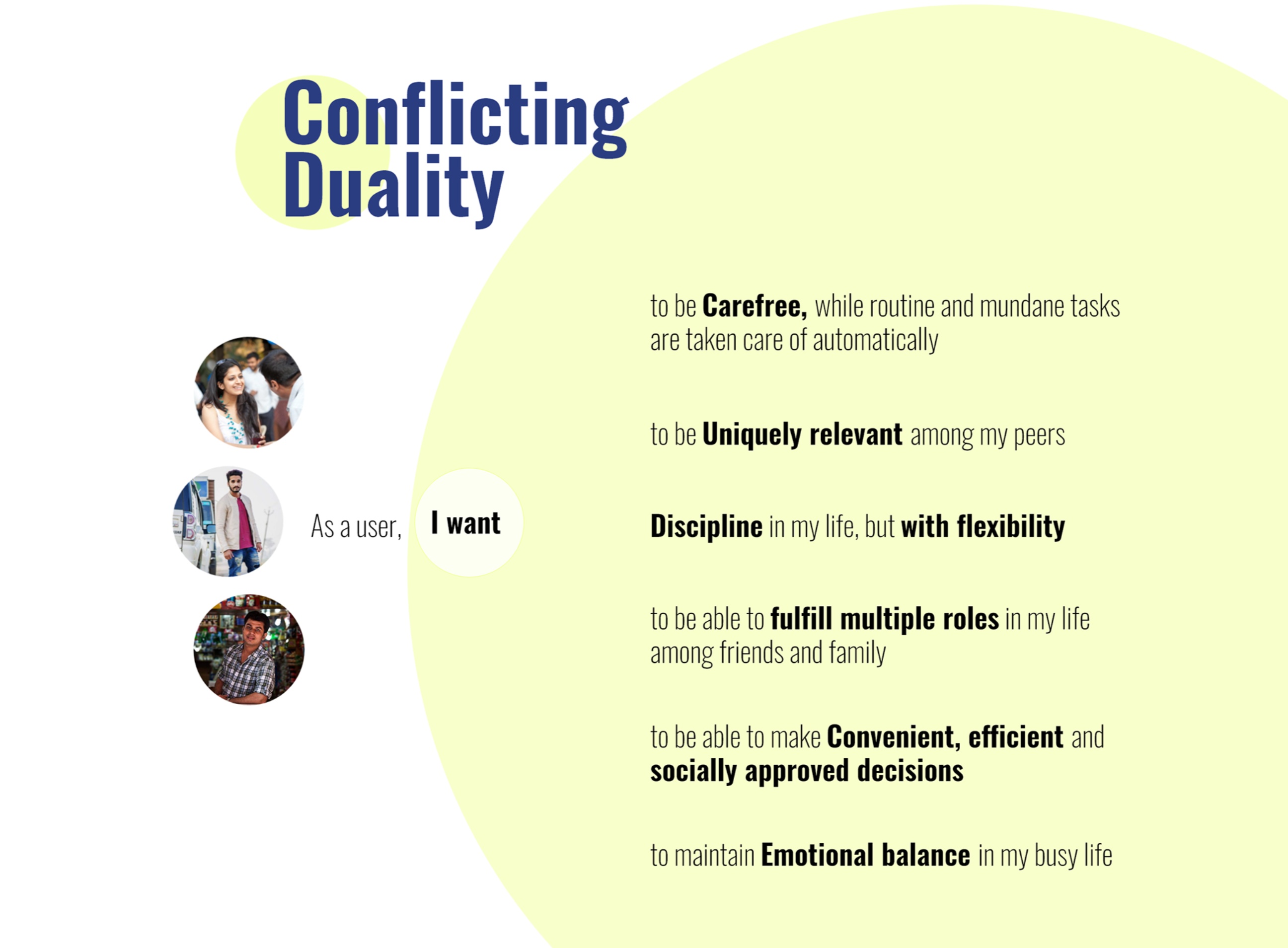
It seemed now apparent that the above 'user needs' require an intelligent solution to existing features and applications of the smartphone but they need to be more consistent with the individual user's expectations. We now needed core principles to define the guidelines for designing solutions (Not discussed in this case study to comply with NDA)
At this point, we conducted a workshop with our Team Lead, to define the principles of an AI solution keeping the user at the center. We wanted our solutions to be:
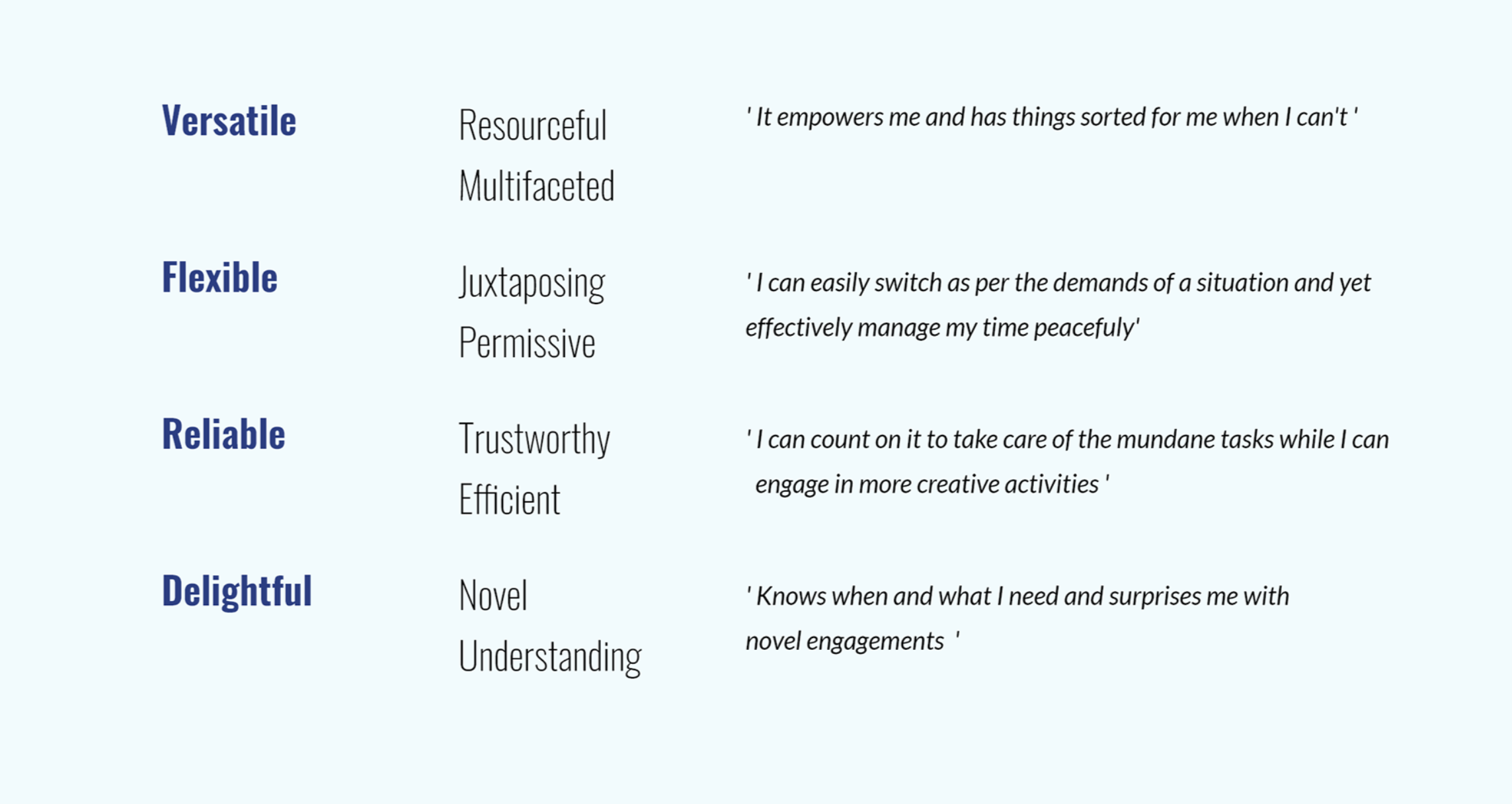
This completes the Phase I of this project. Phase II is discussed as a separate case study.
The insights gave us powerful reason for 'Why' AI is needed and provided the direction to the immensely wide possibilities of AI to provide the focus areas to deliver a meaningful solution to the users.
We now had a strong foundation for ideation that is supported by a known set of technologies making the ideation more realistic with support from the tech team.
I believe the needs generated are kind of universal and not just specific to India. We shared these insights with other teams as well and were used for projects other than AI as well.
Working on a large project involving exhaustive exercises, field work, planning timelines and sticking to them, team debates, and discussions naturally teaches one a lot. Here are my learnings:
Having people from diverse backgrounds is a huge asset to a team for it helped us see many different perspectives especially when we were interpreting user statements. I was luck to be a part of this team.
This was the first time I collaborated with the developers at an initial discovery stage of the project. There was much to learn on feasibility aspects of certain technology and how it works.
This method helped us define 'Who' we were designing for and made it easier for teams other than UX to understand what the consumers need and empathized with them